A reformed, effective public service, is a minimum condition for South Africa to achieve the accelerated levels of economic growth which are necessary to start dealing with the country’s societal problems.
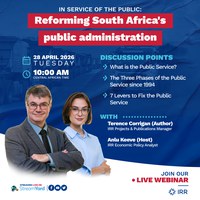
This is the message from the Institute of Race Relations (IRR) in a new report – In Service of the Public: Reforming South Africa’s Public Administration – launched today.
Author Terence Corrigan argues in today’s webinar that South Africa confronts a fatal contradiction in its policy and governance development. Successive governments since 1994 have seen the state as a developmental engine, and even the country’s Constitution was written with this ideal in mind; but the public service has never been able to deliver this as a result of design flaws and political choices.
The legislation governing South Africa’s public service places enormous power in political officers – ministers and MECs – to influence the workings of institutions that are nominally non-partisan and meant to be staffed by professionals. On top of this is the conscious decision of the ANC in the 1990s to politicise appointments through cadre deployment.
This constituted the country’s original state capture and contributed undermining the state’s capacity.
“It is trite to say that governments don’t create business and employment, but they have an enormous influence on the economic environment,” says Corrigan. “In South Africa, administrative dysfunction has made the state a hindrance to economic growth.”
Fortunately, there has been official recognition of the dire state of public administration. The amendment to the Public Service Act that President Ramaphosa signed into law begins the process of depoliticisation through limiting politicians’ roles in staff matters.
While this is a start, much more remains to be done. “A key risk is that there has been much ideological investment in exerting political control over the public service. It has also become a system of patronage and outright corruption. Expect significant resistance.”
The paper puts forward a suite of recommendations to reset the public service. These include far-reaching institutional reforms. Central to this would be to place the public service under a reconstituted Public Service Commission – putting clear distance between the political and administrative functions of the state.
There is also a need to rethink the management and leadership culture within the public service. Managers need to take responsibility for their departments and subordinates and should be supported by their superiors in doing so. Evading responsibility through surrendering these tasks to human resource departments (and allowing human resource departments to undermine management functions) cannot be accepted.
“Above all,” says Corrigan, “there needs to be a change of mindset. A well-functioning public service would be a career of choice and attract some of the best and brightest. It would be a major asset to resolving our economic growth and developmental challenges. The reality is that too much emphasis has been put on secondary matters. Political control is foremost, with demographic representivity following close behind. This must change. A public service that can promote our economic fortunes is one that is a highly skilled and highly motivated meritocracy. We need to choose that.”
Media contact: Terence Corrigan IRR projects and publications manager Tel: 066 470 4456 Email: terence@irr.org.za
Media enquiries: Michael Morris Tel: 066 302 1968 Email: michael@irr.org.za
 IRR welcomes crypto rethink, calls for exchange controls to be scrapped
Oct 22, 2026
IRR welcomes crypto rethink, calls for exchange controls to be scrapped
Oct 22, 2026
 UCT and free speech: the cost of punishing ideas | Michael Morris - Biznews
Oct 21, 2026
UCT and free speech: the cost of punishing ideas | Michael Morris - Biznews
Oct 21, 2026
 Foreigners aren’t taking SA jobs. Bad policy is | Chris Patterson - Biznews
Oct 20, 2026
Foreigners aren’t taking SA jobs. Bad policy is | Chris Patterson - Biznews
Oct 20, 2026
 Cut BEE premiums to spend more on service delivery, IRR urges Godongwana
Oct 20, 2026
Cut BEE premiums to spend more on service delivery, IRR urges Godongwana
Oct 20, 2026
 BEE enriches few, harms many and should be scrapped – IRR
Oct 20, 2026
IRR welcomes crypto rethink, calls for exchange controls to be scrapped
Oct 22, 2026
UCT and free speech: the cost of punishing ideas | Michael Morris - Biznews
Oct 21, 2026
Foreigners aren’t taking SA jobs. Bad policy is | Chris Patterson - Biznews
Oct 20, 2026
Cut BEE premiums to spend more on service delivery, IRR urges Godongwana
Oct 20, 2026
BEE enriches few, harms many and should be scrapped – IRR
Oct 20, 2026
BEE enriches few, harms many and should be scrapped – IRR
Oct 20, 2026
IRR welcomes crypto rethink, calls for exchange controls to be scrapped
Oct 22, 2026
UCT and free speech: the cost of punishing ideas | Michael Morris - Biznews
Oct 21, 2026
Foreigners aren’t taking SA jobs. Bad policy is | Chris Patterson - Biznews
Oct 20, 2026
Cut BEE premiums to spend more on service delivery, IRR urges Godongwana
Oct 20, 2026
BEE enriches few, harms many and should be scrapped – IRR
Oct 20, 2026
