Fostering a competent, professional public service is foundational to South Africa’s prospects for economic growth and future resilience as a constitutional democracy. The failure to create such institutions in the three decades since the transition, and the consequent administrative dysfunction, poses a grave danger to South Africa’s economic growth prospects, and to its endurance as a democracy.
This is the thrust of the latest report from the Institute of Race Relations (IRR), In Service of the Public: Reforming South Africa's Public Administration, which analyses the origins of the country’s public service, the considerable problems afflicting it, as well as recent developments, and argues that it needs to be reformed and reoriented in order to quality as “fit for purpose”.
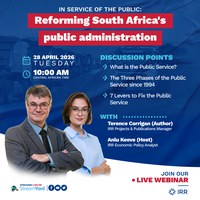
The report will be launched at a webinar next Tuesday.
“Without a properly functioning public service,” says the author of the report, Terence Corrigan, “government in South Africa is more likely to be a hindrance to economic development than an enabler.”
The roots of dysfunction are traced back to the early days of the transition to democracy. The Public Service Act accorded extensive powers over staff matters to political office bearers – ministers and provincial MECs. The career of virtually any member of the public service became potentially subject to political influence.
This was compounded by the African National Congress’s “cadre deployment” initiative, which sought to capture the state apparatus for the party. This was in flat contradiction to the constitutional requirement that the public service be non-partisan, career-oriented and developmental in its work.
“The reality,” says Corrigan, “is that much of the public service is barely able to perform its minimal administrative tasks. As an enabler of developmental governance – the so-called ‘developmental state’ agenda that was all the rage a decade or so ago – it is woefully deficient. This is largely a consequence of the conscious choices by policy makers and the ANC.”
The report comes shortly after President Ramaphosa signed into law an amendment to the Public Service Act, which reorients the lines of authority, removing the direct influence from political heads. This is a significant development.
Corrigan cautions, however, that much remains to be done.
“The amendment is a big step in the right direction. However, it does not deal with the cumulative effects of politicisation and its dire impact on public service professionalism. That will need to be addressed. Many public servants no doubt see themselves as serving a particular party or ideology, and not the state as an institution that must serve all equally and with due regard for its constitutional obligations. Revelations about senior public servants briefing ANC ‘study groups’ to the exclusion of other parties are deeply concerning. The risk exists that political control and partisanship will continue informally – through WhatsApp groups, say, rather than ministerial instructions – but no less destructively.”
The report makes a number of further recommendations for the public service. These include placing a premium on suitable skills, recognising the imperatives of sound management, and the judicious use of technology.
Webinar details:
Date: 28 April
Time: 10am to 11am
Participants: Terence Corrigan (Author), IRR Projects and Publications Manager
Anlu Keeve (Host), IRR Economic Policy Analyst
Register: https://streamyard.com/watch/UvpUnnFJXNKe
Media contact: Terence Corrigan IRR projects and publications manager Tel: 066 470 4456 Email: terence@irr.org.za
Media enquiries: Michael Morris Tel: 066 302 1968 Email: michael@irr.org.za
 IRR welcomes crypto rethink, calls for exchange controls to be scrapped
Oct 22, 2026
IRR welcomes crypto rethink, calls for exchange controls to be scrapped
Oct 22, 2026
 UCT and free speech: the cost of punishing ideas | Michael Morris - Biznews
Oct 21, 2026
UCT and free speech: the cost of punishing ideas | Michael Morris - Biznews
Oct 21, 2026
 Foreigners aren’t taking SA jobs. Bad policy is | Chris Patterson - Biznews
Oct 20, 2026
Foreigners aren’t taking SA jobs. Bad policy is | Chris Patterson - Biznews
Oct 20, 2026
 Cut BEE premiums to spend more on service delivery, IRR urges Godongwana
Oct 20, 2026
Cut BEE premiums to spend more on service delivery, IRR urges Godongwana
Oct 20, 2026
 BEE enriches few, harms many and should be scrapped – IRR
Oct 20, 2026
IRR welcomes crypto rethink, calls for exchange controls to be scrapped
Oct 22, 2026
UCT and free speech: the cost of punishing ideas | Michael Morris - Biznews
Oct 21, 2026
Foreigners aren’t taking SA jobs. Bad policy is | Chris Patterson - Biznews
Oct 20, 2026
Cut BEE premiums to spend more on service delivery, IRR urges Godongwana
Oct 20, 2026
BEE enriches few, harms many and should be scrapped – IRR
Oct 20, 2026
BEE enriches few, harms many and should be scrapped – IRR
Oct 20, 2026
IRR welcomes crypto rethink, calls for exchange controls to be scrapped
Oct 22, 2026
UCT and free speech: the cost of punishing ideas | Michael Morris - Biznews
Oct 21, 2026
Foreigners aren’t taking SA jobs. Bad policy is | Chris Patterson - Biznews
Oct 20, 2026
Cut BEE premiums to spend more on service delivery, IRR urges Godongwana
Oct 20, 2026
BEE enriches few, harms many and should be scrapped – IRR
Oct 20, 2026
