Terence Corrigan
Nearly a decade ago, in 2017, Africa in Fact ran a piece titled ‘Africa’s presidents and the term-limit controversy’. It described a strategy incumbent leaders used to cling to office beyond the limits imposed by their respective constitutions. As it typically emerged from a constitutional change designed to give a sitting head of state something beyond the specified two terms, it was given the shorthand moniker “third termism”.
This phenomenon suggested a misdirection in Africa’s democratic evolution. If the continent had made progress in moving away from the military coup, which had been such a feature of African politics since the 1960s, analysts identified this as the “constitutional coup”.
At the time, this issue was in focus as Rwanda’s long-serving president, Paul Kagame, was running for re-election, having already held the country’s presidency since 2000. In 2003, Rwanda adopted a new constitution which limited presidential incumbents to two seven-year terms. But in 2015, a constitutional amendment changed the framework. Kagame would be permitted to contest a third term, after which a new regime would revise individual presidential terms to five years while limiting future incumbents to two terms. Kagame would be eligible to run for these as well.
This he did. Presenting himself for re-election in 2024, he won well over 99% of the vote in a poll widely criticised for intimidation and as fraudulent. He is expected to stand again in 2029, which could see him hold the office until 2034. Beyond that is anyone’s guess. Kagame will be 79 by then, but he has become so deeply identified with the ruling Rwandan Patriotic Front (and the Rwandan state itself) that it’s hardly unthinkable that another accommodation might be made to further prolong his time in office.
It’s worth bearing in mind that in 2017, Rwanda was viewed as a rare developmental success in Africa; Kagame was held up in many quarters as indispensable to this, despite his authoritarian impulses. The same cannot be said for many others attempting the same thing.
One of these, today, is Zimbabwe’s Emmerson Mnangagwa. Taking power through a military coup in 2017 – precisely the sort of transition that Africa was supposed to have left behind – Mnangagwa proceeded to operate very much in the mould of the continent’s old-school autocrats. Not only did he have a questionable history in Zimbabwe’s feared internal security apparatus, but as president, he presided over the ongoing suppression of dissent, electoral manipulation and corrosive patronage. To this, he and his government have added the strategies of a modernised autocracy, including an engineered extension of his term of office.
A pending constitutional amendment aims to expand the powers of the Zimbabwean executive, removing direct elections for the presidency while extending his term from five to seven years. This would mean, in effect, that Mnangagwa, now 83, would not step down in 2028 but could remain in office until 2030. From there, perhaps another extension could be made. Zimbabwe, after all, has extensive experience with superannuated presidents holding office.
These sentiments hold for much of the continent’s democratic journey. And hence the importance of the descriptor “constitutional coup” and why it is more than a rhetorically balanced turn of phrase.
Isabel Bosman-Burnett, a researcher in African governance and diplomacy at the South African Institute of International Affairs, told Africa in Fact, “I think the term ‘constitutional coup’ is a useful one and describes something that seems to be on the rise. Yes, the extension of presidential terms poses a danger to African democracy (but also democracies elsewhere) because it allows a single party or individual to monopolise power and creates an unhealthy democratic environment where opposition voices are either discouraged or silenced (often forcefully). It defeats the objective of allowing voters to hold leaders accountable and demand change peacefully through the ballot because it is not generally the case that leaders who extended presidential term limits step down. When presidential term limits are extended, it should be a warning that a country is drifting further away from democracy and heading down a path towards authoritarianism. Unlimited presidential terms are incompatible with democracy and oppose key values like the rule of law and processes of checks and balances.”
The invariable argument made in favour of extending an incumbent’s term is that he or she is a necessary driver of the country’s developmental prospects. As previously noted, this justification was prominent in Kagame’s case; it has also typically referenced the role of iconic figures elsewhere in the world, such as Singapore’s Lee Kuan Yew. Retaining a competent and popular leader is, in this view, an eminently democratic choice. And in any event, several leading democracies have imposed no term limits on their leaders.
For Africa, though, it’s an issue that needs to be seen in relation to the continent’s unsteady democratic trajectory. While there is copious evidence that Africa’s people remain committed to democracy, the same cannot always be said of its elites. And democratic commitment has been strained by a perceived failure across the continent to achieve the developmental gains hoped for. Persistent socio-economic deprivation and insecurity, as well as the assertion by authoritarian actors globally of the legitimacy of their models, have opened the door for arguments that democratic restraints are dispensable in the interests of development and cohesion.
Yet sensibilities demand, for the most part, nominal adherence to democratic norms. Elections must be held, and the form of democracy kept in place, but its substance – democratic unpredictability and the prospects of change – is strictly constrained. This is what the political scientist Andreas Schedler has called the “menu of manipulation”.
Scholars and democracy advocates correctly see the term limit controversy as a democratic hazard. According to a 2021 analysis by Joseph Siegle and Candace Cook of the Africa Center for Strategic Studies, a think tank in the United States, long-term incumbency buttressed by term-limit manipulations is associated with numerous pathologies, such as greater corruption and being more prone to conflict than peer countries whose leaders relinquish power timeously.
For Ambassador Aderemi Ajibewa, professor of international relations and former director of political affairs at the Economic Community of West African States (ECOWAS), what begins with a “constitutional coup” can shift a country’s political prospects towards more violent and openly undemocratic outcomes: “These practices blur the lines between formal electoral democracy and authoritarian governance, eroding public trust and inadvertently creating conditions conducive to military interventions.”
This is not to be underestimated, as the military coup itself has re-emerged as a feature of the continent’s politics, attracting some genuine enthusiasm; where elected governments cannot provide security or prosperity, the hard edge of “can-do” authoritarianism can appear appealing.
Ambassador Ajibewa points out that term extensions have an impact beyond individual countries. Formally, the African Union (AU) requires adherence to democratic norms, the framework for which is set out in the 2000 Declaration on the Framework for an OAU (Organisation of African Unity) Response to Unconstitutional Changes of Government and the 2007 African Charter on Democracy, Elections and Governance.
These documents require regular elections as the primary means to change governments. They demand respect for countries’ constitutions. They condemn coups and the refusal of incumbents to leave office. Thus, the recent military takeovers – popular or not with their respective populations – are generally condemned. (In practice, responses are inconsistent; in the case of Zimbabwe in 2017, after some initial concerns were expressed, both the AU and the South African Development Community acquiesced in the military’s actions.)
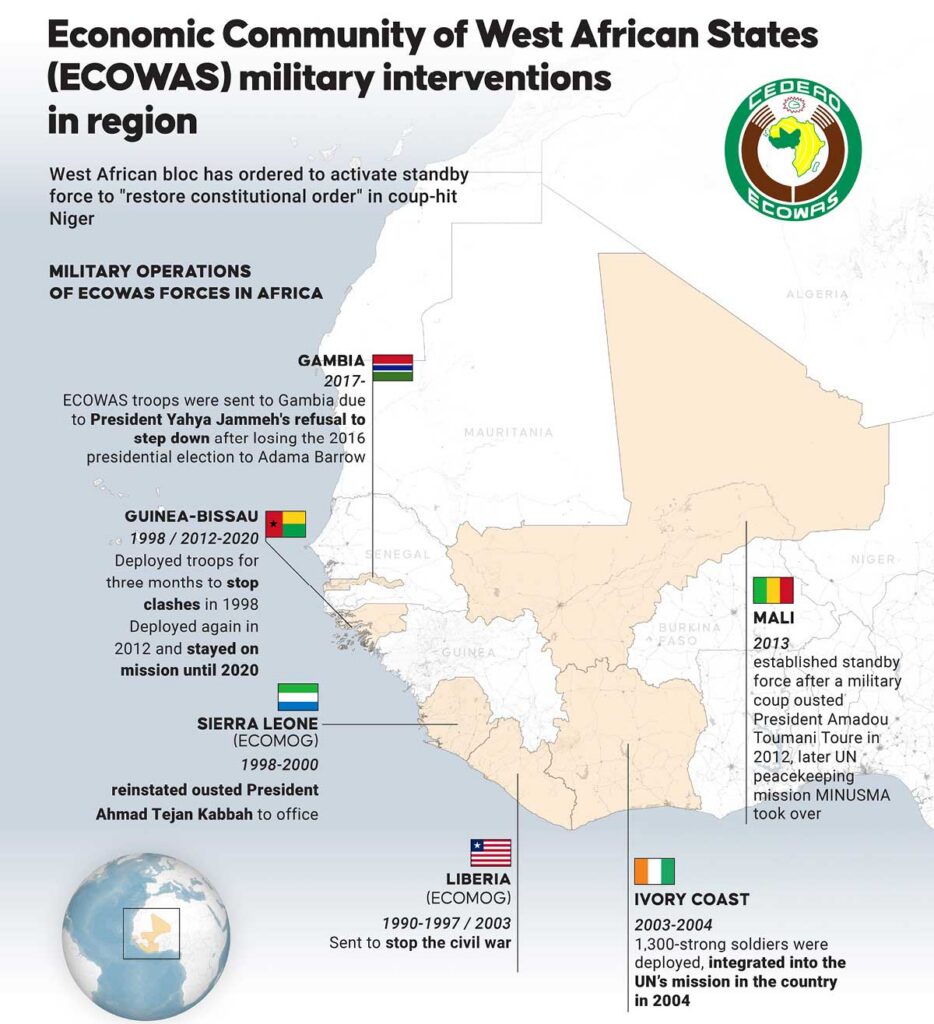
Term limits and perpetual incumbencies, however, are what Ambassador Ajibewa calls a “normative grey area”. ECOWAS has experienced a number of cases of this – in Côte d’Ivoire, Guinea, and Togo, for example – and has attempted to establish regional instruments to address it. He points to the ECOWAS Protocol on Democracy and Good Governance, which restricts amendments to constitutions or electoral laws six months prior to an election. But this constitutes weak protection, as such changes can be introduced before this window. Elections are then held with these changes being a fait accompli.
“This grey area complicates the AU’s and the Regional Economic Community’s (REC) responses,” Ambassador Ajibewa continues, “as these transitions technically adhere to constitutional procedures but go against democratic principles. The AU and REC face difficulties in addressing these without clearer, enforceable frameworks for addressing such democratic backslides. Constitutional coups disrupt political stability and undermine democratic progress in Africa.”
This is the crux of the issue. The visuals of camo-clad soldiers escorting the civilian cabinet to detention are clear and comprehensible. Those of a familiar figure in a tailored suit, solemnly taking a third or fourth oath of office, are much more ambiguous.
Constitutional coups exist with a veneer of respectability and are articulated in a vocabulary of democracy. But in so doing, they skew the operation and incentives in democratic systems, reducing constitutional strictures from robust elements of democratic architecture that need to be respected and navigated into obstacles to be overcome and reconstituted for the advantage of the incumbent. The constitutional coup denotes not only the abuse of political power by a particular executive but also the corrosion of constitutionalism itself.
And precisely for this reason, the constitutional coup is arguably more damaging than the military coup. It is a strategy that risks trapping a country in a permanent democratic grey zone. This is politics and governance that display a democratic form while denuding it of a significant part of its democratic substance. With leaders keeping themselves in power by shifting the constitutional order to suit themselves, the political order would invariably ossify around them. The institutions necessary for a durable constitutional democratic order would struggle to mature. And as Siegle and Cook argue, this opens the door to the “big man” style of governance that characterised Africa before its democratic transitions.
How should the continent and its people respond? Part of the answer, of course, lies in the country-level activism that, over the past three decades, has confronted and sometimes defeated attempts to abrogate term limits. But this must be paired with the acknowledgement that, since 2017, the overall state of democracy on the continent has deteriorated. The stakes are, in a sense, higher.
Similarly, continental and regional bodies need to insist on term-limit conventions and treat their undermining as an unacceptable breach of democratic norms. Ambassador Ajibewa told Africa in Fact that a response must also account for the genuine frustrations of people at governance failings and how this has made non-democratic options attractive. This would apply to both those who see salvation in a (supposedly) resolute military regime and those who place their faith in the perpetual incumbency of an individual.
All of this also demands making the case for the importance of term limits and their place in democratic systems. Says Bosman-Burnett: “Term limits are not undemocratic. On the contrary, they are a democratic safeguard. Elected leaders get a limited time to deliver on the promises of democratic governance, and when, in the assessment of the electorate, they are not performing or their time is up, other candidates should be able to step in.”
Dr Greg Mills, veteran South African international affairs scholar and convenor of the Platform for African Democrats, adds that not only are extended incumbencies harmful to democracies, but they are also invariably ineffective in dealing with the problems they claim to exist to tackle. “Despite the recurrent enthusiasm for authoritarianism as a model to ‘get things done’, the sort of ‘benign dictator’ who is not corrupt but efficient, who maintains a paternalistic but admirable benevolence, almost never exists,” says Mills.
“The reality of such a model is, for the most part, quite different. Few of Africa’s dictators have proven benign or developmentally astute. Most end their rule in chaos or violence, usually fatally so for the leadership.” Indeed, in recent years, these critiques have been directed at the Rwandan experience, arguing that its impressive story has been built on aid dependency, repression and a highly selective narrative. Seen thus, Kagame’s refusal to vacate office was less a guarantee of success than a threat of regression.
“History and human nature teach us that power is seductive,” observe Siegle and Cook. This is the danger inherent in “third termism”. At a moment when the continent faces a resurgent wave of military coups, the constitutional coup might seem esoteric and a secondary concern. For those invested in Africa’s democratic success, this would be a grave mistake.
 Meyer's rejection of "white genocide" supported by majority of South Africans - IRR
Sep 29, 2026
Meyer's rejection of "white genocide" supported by majority of South Africans - IRR
Sep 29, 2026
 MICHAEL MORRIS | A free society produces a rich diversity of cultures and traditions - Business Day
Sep 28, 2026
MICHAEL MORRIS | A free society produces a rich diversity of cultures and traditions - Business Day
Sep 28, 2026
 DAVID CHRISTIANSON | Why economic growth needs strong local government - Business Day
Sep 21, 2026
DAVID CHRISTIANSON | Why economic growth needs strong local government - Business Day
Sep 21, 2026
 Scrap race laws for SA’s sake, not Washington’s – IRR
Sep 17, 2026
Scrap race laws for SA’s sake, not Washington’s – IRR
Sep 17, 2026
 IRR Legal applauds ConCourt decision on public procurement
Sep 17, 2026
Meyer's rejection of "white genocide" supported by majority of South Africans - IRR
Sep 29, 2026
MICHAEL MORRIS | A free society produces a rich diversity of cultures and traditions - Business Day
Sep 28, 2026
DAVID CHRISTIANSON | Why economic growth needs strong local government - Business Day
Sep 21, 2026
Scrap race laws for SA’s sake, not Washington’s – IRR
Sep 17, 2026
IRR Legal applauds ConCourt decision on public procurement
Sep 17, 2026
IRR Legal applauds ConCourt decision on public procurement
Sep 17, 2026
Meyer's rejection of "white genocide" supported by majority of South Africans - IRR
Sep 29, 2026
MICHAEL MORRIS | A free society produces a rich diversity of cultures and traditions - Business Day
Sep 28, 2026
DAVID CHRISTIANSON | Why economic growth needs strong local government - Business Day
Sep 21, 2026
Scrap race laws for SA’s sake, not Washington’s – IRR
Sep 17, 2026
IRR Legal applauds ConCourt decision on public procurement
Sep 17, 2026
