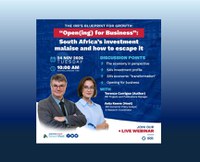
At the heart of South Africa’s multifaceted crises lies a chronic, decades-long inability to attract the levels of investment that its peer markets are routinely able to achieve, the Institute of Race Relations argues in a new study, “Open(ing) for business”: South Africa’s investment malaise and how to escape it.
Introducing the study at a webinar this morning, author Terence Corrigan said the starting point for understanding South Africa’s economic malaise was that opportunities and rising living standards depended on economic growth. This was driven by the sustained levels of investment.
For South Africa, it is generally acknowledged that making a dent in unemployment and poverty would need a rate of growth in excess of 5% per year – roughly the rate of other middle-income economies around the world. South Africa’s economy has been scraping by at below 2% for over a decade. Investment – the commitment of resources to productive activity over time – comes in at around a paltry 15% of GDP. By contrast, the average for middle-income markets has been over 30% for close to two decades.
“South Africa’s economy is barely committing enough to keep existing assets in service,” Corrigan explained. “We are not expanding our productive base. Compare that to our peers. Middle-income countries have been the prime beneficiaries of globalisation, and this is largely passing South Africa by. In fact, we are behind not only the middle-income average, but the average for high-income and low-income countries too.
“Simply put, South Africa is an investment laggard,” he said.
This is, the report notes, not only a matter of foreign investment. South African businesspeople have long been reluctant to commit their capital to the economy, often preferring to keep funds as savings.
“This is often erroneously decried as reflecting a lack of patriotism,” Corrigan continued, “In reality it reflects a hard economic calculation. The private sector is by a large margin actually the dominant investor in South Africa, dwarfing public investment. But South Africa is simply not an attractive proposition for investors and businesspeople. There is enormous fanfare when a new factory is opened, but we are seeing a steady departure of some big names, and more to the point, there are the billions of rands in investment that simply never came in the first place.”
Pathologies across South Africa’s economic landscape have created this situation. The report demonstrates how foundational problems – such as crime and infrastructure collapse – impose enormous costs on doing business. The World Bank has estimated, for example, that crime costs the South African economy the equivalent of 9.6% of GDP annually. Governance failures, such as ill-judged licencing regimes, empowerment demands, education and training deficiencies, and general administrative incompetence (a matter of relevance in the wake of the municipal elections) not only impose extreme costs, but undermine the predictability that businesses need to navigate the present and prepare for the future.
The South African state has also attempted to position itself as a “developmental” agent, but it doesn’t remotely have the capacity to fulfil this role. This has led to policy capture by particular business interests, and a dogged refusal on the part of the government to examine its policy assumptions.
Taken together, South Africa cannot make a compelling economic case for the scale of investment that the country requires. Attempts to circumvent this through conferences or investment junkets are ultimately futile. “Capital goes where it is well-treated”, an international banker is quoted as saying.
All of this has critical societal implications.
Corrigan commented: “While ‘investment’ is often regarded as a highbrow, abstract concept, or – in some circles – even as something to be disregarded entirely, it is the lifeblood of an economy, and essential to dealing with the economic exclusion that afflicts millions of South Africans. We diminish its importance at our peril, not only to our economic fortunes, but to those of South Africa’s future as a constitutional democracy. We have seen polling evidence that increasing numbers of South Africans would countenance an authoritarian takeover if it could address socio-economic maladies.”
The report proposes a far-reaching programme of administrative and policy reform to address these issues, with a view to raising the investment rate to 30% and above over time.
“This will demand hard political choices and require political will. But South Africa’s future could well depend on it,” Corrigan concluded.
Media contact: Terence Corrigan IRR projects and publications manager Tel: 066 470 4456 Email: terence@irr.org.za
Media enquiries: Michael Morris Tel: 066 302 1968 Email: michael@irr.org.za
 Johannesburg chlorine spend illustrates need for value-for-money procurement
Nov 23, 2026
 MICHAEL MORRIS | South Africa needs to do things differently, sooner - Business Day
Nov 23, 2026
 The GNU will end. The battle over who gets the blame will decide the next election - Biznews
Nov 20, 2026
 IRR pitches value for money as key coalition binding agent
Nov 20, 2026
 South Africans are ready for a president of any race. Why are commentators so surprised? - Mail & Guardian
Nov 19, 2026
Johannesburg chlorine spend illustrates need for value-for-money procurement
Nov 23, 2026
MICHAEL MORRIS | South Africa needs to do things differently, sooner - Business Day
Nov 23, 2026
The GNU will end. The battle over who gets the blame will decide the next election - Biznews
Nov 20, 2026
IRR pitches value for money as key coalition binding agent
Nov 20, 2026
South Africans are ready for a president of any race. Why are commentators so surprised? - Mail & Guardian
Nov 19, 2026
