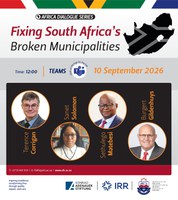
South Africa cannot achieve the economic growth it desperately needs while its cities and towns struggle to provide the infrastructure and services on which businesses and households depend, says a new analysis published by the Institute of Race Relations today.
The paper, Local government: crises decades in the making and how to deal with them, argues that the quality of municipal government will have a decisive influence on South Africa’s ability to attract investment, support businesses and generate employment – and that, right now, its influence is negative.
This dynamic is particularly important in the major metropolitan areas. The eight metropolitan municipalities account for about 59% of total municipal spending. They also account for well over half of South Africa’s economic output and employment: according to figures cited in the paper, the metros produced 57% of GDP and 53% of employment in 2023.
“Municipal failure in South Africa’s major cities cannot be dismissed as a matter of local quality of life,” says the paper’s author, Terence Corrigan. “The consequences extend into the national economy.”
South Africa’s local government sphere – outside a relatively small number of high-performers – has been dogged by poor governance, perpetual financial difficulties and ineffective administration. This has manifested itself in the well-known symbols of municipal decline such as deteriorating infrastructure, unreliable water and electricity provision, potholed roads, and decrepit sewage systems. Increasingly, this is being compounded by unstable and recklessly transactional coalition governments and the penetration of organised crime into municipal systems.
The problem is particularly acute as South Africa continues to urbanise. Around 64% of the population is now urban, with this is projected to reach about 78% by 2050. Globally, cities are the engines of the modern economy; mismanaged, they can be its graveyard.
This makes municipal reform an economic-growth priority.
South Africa’s challenge will be not only to accommodate a growing urban population, but to ensure that cities become the site of productive activity.
For this reason, the IRR argues for treating municipal reform as part of South Africa’s broader growth agenda.
Fostering growth-oriented local government consequently demands acknowledging the complexity of the challenges confronting it and the varying responses required to meet them. This includes standard and well-worn recommendations such as professionalising municipal administrations, improving financial management, and taking infrastructure maintenance seriously. It also means accepting that major elements of the existing municipal design need to be rethought, and recognising the growing role that criminality is playing in South Africa’s local government crisis.
Each of these requires political decisions, and taking them may be the toughest part of a reform process. But failing to take them will have dire consequences for the country.
“South Africa’s economic future is increasingly urban,” says Corrigan. “If its cities and towns cannot function effectively, the country will not realise the economic growth dividend that comparable societies have achieved.”
The report was produced with the generous support of the Konrad Adenauer Stiftung.
Media contact: Terence Corrigan IRR projects and publications manager Tel: 066 470 4456 Email: terence@irr.org.za
Media enquiries: Michael Morris Tel: 066 302 1968 Email: michael@irr.org.za
 IRR welcomes crypto rethink, calls for exchange controls to be scrapped
Oct 22, 2026
IRR welcomes crypto rethink, calls for exchange controls to be scrapped
Oct 22, 2026
 UCT and free speech: the cost of punishing ideas | Michael Morris - Biznews
Oct 21, 2026
UCT and free speech: the cost of punishing ideas | Michael Morris - Biznews
Oct 21, 2026
 Foreigners aren’t taking SA jobs. Bad policy is | Chris Patterson - Biznews
Oct 20, 2026
Foreigners aren’t taking SA jobs. Bad policy is | Chris Patterson - Biznews
Oct 20, 2026
 Cut BEE premiums to spend more on service delivery, IRR urges Godongwana
Oct 20, 2026
Cut BEE premiums to spend more on service delivery, IRR urges Godongwana
Oct 20, 2026
 BEE enriches few, harms many and should be scrapped – IRR
Oct 20, 2026
IRR welcomes crypto rethink, calls for exchange controls to be scrapped
Oct 22, 2026
UCT and free speech: the cost of punishing ideas | Michael Morris - Biznews
Oct 21, 2026
Foreigners aren’t taking SA jobs. Bad policy is | Chris Patterson - Biznews
Oct 20, 2026
Cut BEE premiums to spend more on service delivery, IRR urges Godongwana
Oct 20, 2026
BEE enriches few, harms many and should be scrapped – IRR
Oct 20, 2026
BEE enriches few, harms many and should be scrapped – IRR
Oct 20, 2026
IRR welcomes crypto rethink, calls for exchange controls to be scrapped
Oct 22, 2026
UCT and free speech: the cost of punishing ideas | Michael Morris - Biznews
Oct 21, 2026
Foreigners aren’t taking SA jobs. Bad policy is | Chris Patterson - Biznews
Oct 20, 2026
Cut BEE premiums to spend more on service delivery, IRR urges Godongwana
Oct 20, 2026
BEE enriches few, harms many and should be scrapped – IRR
Oct 20, 2026
