In 2012 the African National Congress (ANC) adopted a National Development Plan (NDP) it said would reduce the unemployment rate to 6% by 2030. That 2030 deadline is four years away. Yet the joblessness rate now exceeds 33%, which means unemployment is 450% greater today than the NDP target.
The ANC has often promised to usher in a “skills revolution”. However, both it and the Government of National Unity (GNU) continue to fail on this front. Drop-out rates remain high in all spheres: from schools and universities to Technical Vocational Education and Training (TVET) colleges and Sector Education and Training Authorities (SETAs).
These are some of the key points in a new report by the IRR, titled Generating Jobs and Skills for Growth and Prosperity, 2026. This is the latest in the IRR’s Blueprint for Growth series. Here, Dr Anthea Jeffery analyses some of the reforms the GNU has recently proposed to help boost jobs and skills. Sadly, none of these policies has much prospect of success.
To counter unemployment, the GNU has put forward a batch of reforms to labour laws. Some of these ideas are helpful in small ways. Most tinker at the edges of bad laws, or make them still more costly and coercive.
On the skills front, the most significant changes are in the TVET sphere. Here, the aim is to modernise curricula, insist that courses include workplace experience, and bring in experts to teach. However, so long as the annual TVET budget remains a paltry R14.6bn, the changes proposed are unlikely to count much.
By contrast, more than R100bn a year goes to “massified” universities, which continue to battle with poorly prepared students and high drop-out rates. In practice, “free” university education remains costly and wasteful. In addition, the National Student Financial Aid Scheme (NSFAS) responsible for implementing it has recently been placed under administration for the third time in eight years.
What, then, is to be done? Relatively minor amendments to labour laws could make it easier for millions to find work, as the report explains, while ineffective SETAs should simply be scrapped. Improving TVETs and universities is significantly more complex and requires a fresh focus.
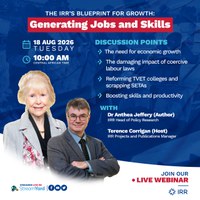
Join us on 18 August for the online launch of the IRR’s new paper. Here, Dr Jeffery and Terence Corrigan, IRR projects and publications manager, will discuss the reforms vital to increased jobs, skills, and growth – and rising prosperity.
Details:
Date: 18 August 2026
Time: 10:00
StreamYard link: https://streamyard.com/watch/zeMnKzA6wrVt
 IRR welcomes crypto rethink, calls for exchange controls to be scrapped
Oct 22, 2026
IRR welcomes crypto rethink, calls for exchange controls to be scrapped
Oct 22, 2026
 UCT and free speech: the cost of punishing ideas | Michael Morris - Biznews
Oct 21, 2026
UCT and free speech: the cost of punishing ideas | Michael Morris - Biznews
Oct 21, 2026
 Foreigners aren’t taking SA jobs. Bad policy is | Chris Patterson - Biznews
Oct 20, 2026
Foreigners aren’t taking SA jobs. Bad policy is | Chris Patterson - Biznews
Oct 20, 2026
 Cut BEE premiums to spend more on service delivery, IRR urges Godongwana
Oct 20, 2026
Cut BEE premiums to spend more on service delivery, IRR urges Godongwana
Oct 20, 2026
 BEE enriches few, harms many and should be scrapped – IRR
Oct 20, 2026
IRR welcomes crypto rethink, calls for exchange controls to be scrapped
Oct 22, 2026
UCT and free speech: the cost of punishing ideas | Michael Morris - Biznews
Oct 21, 2026
Foreigners aren’t taking SA jobs. Bad policy is | Chris Patterson - Biznews
Oct 20, 2026
Cut BEE premiums to spend more on service delivery, IRR urges Godongwana
Oct 20, 2026
BEE enriches few, harms many and should be scrapped – IRR
Oct 20, 2026
BEE enriches few, harms many and should be scrapped – IRR
Oct 20, 2026
IRR welcomes crypto rethink, calls for exchange controls to be scrapped
Oct 22, 2026
UCT and free speech: the cost of punishing ideas | Michael Morris - Biznews
Oct 21, 2026
Foreigners aren’t taking SA jobs. Bad policy is | Chris Patterson - Biznews
Oct 20, 2026
Cut BEE premiums to spend more on service delivery, IRR urges Godongwana
Oct 20, 2026
BEE enriches few, harms many and should be scrapped – IRR
Oct 20, 2026
