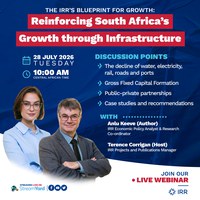
Behind every dry tap and broken railway is a decision taken in an office, and the cumulative effect of those decisions is weighing heavily on South Africa’s economy.
That is the central argument of the presentation at today’s online launch of Reinforcing South Africa's growth through infrastructure, the latest in the Blueprint for Growth series published by the Institute of Race Relations (IRR).
South Africa has been trapped in a damaging policy-infrastructure-growth loop since about 2008. Income per person is now lower than it was 17 years ago, while several comparable economies, including Colombia, Brazil and Malaysia, have increased their per capita incomes over the same period.
IRR Economic Policy Analyst Anlu Keeve, the author of the report, argues that South Africa’s infrastructure failure and its prolonged economic stagnation are closely related. Failing infrastructure is a growth problem when:
Keeve explains: “Behind every dry tap and railway failure is a decision taken in an office. In this way, infrastructure failure is a growth problem, with a policy cause. The country has the capital and the expertise. What has been missing is the decision to let the people who can do the work get on with it, and to hold them to account when they don't."
The paper argues that reversing the decline must begin with restoring the basic disciplines on which functioning infrastructure depends: routine maintenance, accurate meters, monitoring, credible data, procurement discipline and clear accountability.
“The unglamorous work is what prevents the expensive failures,” says Keeve.
South Africa therefore faces a choice. It can continue recycling policies that have produced deteriorating infrastructure, weaker investment and declining income per person, or it can change the rules that determine who may build, finance, operate and maintain the systems on which the economy depends.
Growth will remain weak for as long as infrastructure failure is treated as an engineering problem alone. The pipes, rails and power lines may be physical assets, but whether they work is ultimately determined by policy.
Media contact: Anlu Keeve IRR Economic Policy Analyst and Research Coordinator Tel: 071 929 9516 Email: anlu@irr.org.za
Media enquiries: Michael Morris IRR Head of Media Tel: 066 302 1968 Email: michael@irr.org.za
 Feeble growth behind steadily worsening unemployment rate – IRR
Oct 02, 2026
Feeble growth behind steadily worsening unemployment rate – IRR
Oct 02, 2026
 92% of #PledgeToVote respondents believe voting makes a difference
Oct 02, 2026
92% of #PledgeToVote respondents believe voting makes a difference
Oct 02, 2026
 Anthea Jeffery: Treasury wants to put Bitcoin behind a border it can't find - Biznews
Oct 01, 2026
Anthea Jeffery: Treasury wants to put Bitcoin behind a border it can't find - Biznews
Oct 01, 2026
 Don’t harm SA’s people when targeting their government, IRR urges US
Oct 01, 2026
Don’t harm SA’s people when targeting their government, IRR urges US
Oct 01, 2026
 Meyer's rejection of "white genocide" supported by majority of South Africans - IRR
Sep 29, 2026
Feeble growth behind steadily worsening unemployment rate – IRR
Oct 02, 2026
92% of #PledgeToVote respondents believe voting makes a difference
Oct 02, 2026
Anthea Jeffery: Treasury wants to put Bitcoin behind a border it can't find - Biznews
Oct 01, 2026
Don’t harm SA’s people when targeting their government, IRR urges US
Oct 01, 2026
Meyer's rejection of "white genocide" supported by majority of South Africans - IRR
Sep 29, 2026
Meyer's rejection of "white genocide" supported by majority of South Africans - IRR
Sep 29, 2026
Feeble growth behind steadily worsening unemployment rate – IRR
Oct 02, 2026
92% of #PledgeToVote respondents believe voting makes a difference
Oct 02, 2026
Anthea Jeffery: Treasury wants to put Bitcoin behind a border it can't find - Biznews
Oct 01, 2026
Don’t harm SA’s people when targeting their government, IRR urges US
Oct 01, 2026
Meyer's rejection of "white genocide" supported by majority of South Africans - IRR
Sep 29, 2026
